
that dress

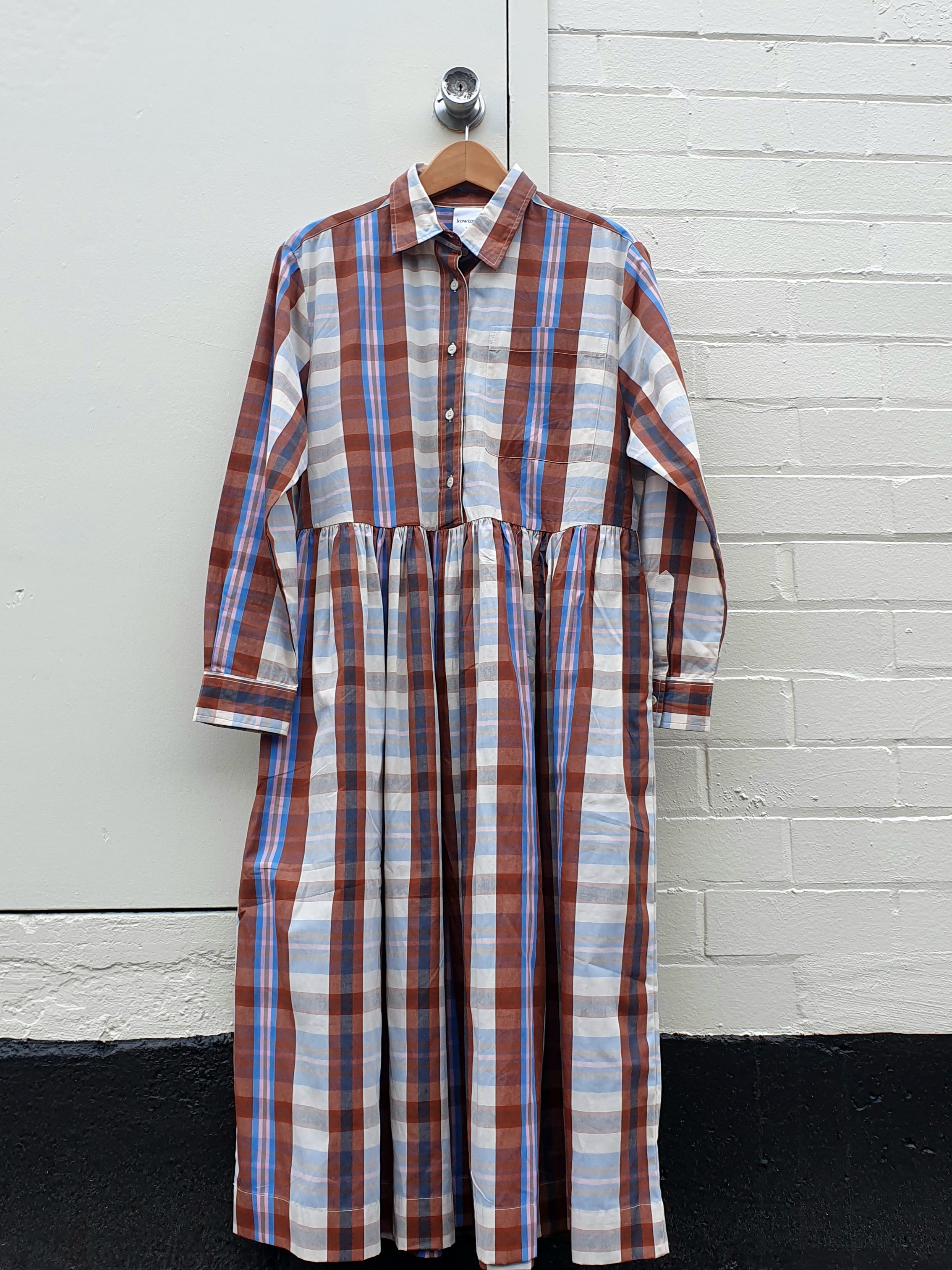
I was so sure I liked that dress. So much so that when, the Christmas before last, I spotted it in the window of my favourite Scandi design store, I forbade myself to enter and try it on, guessing its price from its label.
That Christmas came and went, and the next time I noticed the checked dress it was hanging on the pavement sale rail, outside the Scandi shop. Still I walked straight past it, like Odysseus strapped to his ship’s mast, refusing to be tempted. Only to weaken, a few days later, and switch to ghosting the dress on-line, waiting like a short-sell trader for the price to come down.
My ex-husband preferred me to wear classic clothes in plain fabrics, with clean lines in unshouty colours. The two of us were together for so long that my taste developed in line with our relationship. Without anything needing to be said, I stayed away from bold colours and strong patterns, sensing that they weren’t quite me. Although, this unspoken agreement shifted when, towards the end of our marriage, James and I pulled in different directions and, in so doing, developed opinions about particular items that each other wore (I disliked him wearing white trousers and he didn’t think buttoned shirts suited me). Still, broadly speaking, style wasn’t an issue for us.
Over the years, two women have had an outsized influence over the clothes that I wear. The first was a friend who came to stay after we finished a big renovation over fifteen years ago. At her encouragement, I pulled every hanger from my wardrobe and lay all my clothes on the bed, before trying them on, one by one, a process that, under Susie’s gentle yet firm eye, halved my wardrobe inside two hours.
The second woman who influenced the way I dress, more than she realised, I met in a café after yoga class, a detail which I think explains why I felt brave enough to approach an attractive silvery blonde woman wearing a tutu skirt early on a Tuesday morning. In the friendship that followed this chance meeting, Freya persuaded me, through her example, to ditch the distinction between back-of-the-wardrobe, good clothes, and everyday, not so good, clothes. Instead she encouraged me to stand in front of my wardrobe every single day and to choose the most interesting option.
I’ll never wear a tutu skirt on a Tuesday morning, or any other day of the week. Still, when I select clothes from my wardrobe, last thing at night before bed, I do so in line with the weather forecast I’ve just checked on my phone, and what most catches my eye. After all, if the clothes I plan to wear the next day don’t excite me, if I’m not looking forward to wearing them, they probably won’t interest anyone else either. While I don’t dress to draw attention to myself, nor do I wear clothes as camouflage.
I’ve stood at the front of a yoga class for long enough to know that people really do look at what I wear, that when I stand in Warrior 1, at the front of the room, I’m an object in their field of vision. (For this reason, I choose to wear black when I teach.) Equally, when I stand at the top of the studio stairs, checking off student’s names before class, they become objects in my field of vision. From the tread of their footsteps, to the clothes they’ve flung over leggings in order to reach class on time, I take it all in. How could I not notice something as obvious as what someone is wearing?
Four and a half years ago, when James left Australia to return to Europe, I felt giddy with the thought that I could wear what I liked, when I liked. I could wear slippers in the evening, with a big jumper over leggings, and not feel remarked on, even when that remark took the form of a sidelong glance rather than actual words.
Except, now that I could wear anything, what did I like to wear? Was the censor that seemed to live inside me, even in James’ absence, part of me? Was it an ingrained habit, a reflex from way back? Or was it a function of the outside world? I knew, from my reading of psychology, that inhibitions are embedded, layer over layer, and therefore particularly resistant to change. So rather than risk embedding them further, by poking at them, I decided to respect them, to leave them alone and leave off trying to understand them. Instead I took a behavioural approach. I just accepted that a change in style, from muted to something bolder, was bound to make me feel uncomfortable. And that I should expect a few bumps and take some risks, even if they brought discomfort.
And so, over the last five years I bought four pieces of clothing in big colours with strident patterns. No more looking over my shoulder, I thought to myself, when I purchased each of these items. I felt determined to wear what I liked, even if I wasn’t completely sure what that was.
As time passed, I got used to my new normal. However, there was a problem, a hitch, that I hadn’t foreseen. Was it my imagination, was it post-Covid, or was I receiving fewer invitations now that I was single, compared with when I was with James? Whatever it was, I had fewer opportunities to wear my new, bold clothes, which (don’t tell Freya) sat idle on their hangers at the back of my wardrobe.
Then one hot day last summer, I jumped again. I picked up the checked dress from the pavement sale rail, marched into the Scandi shop, and asked to try it on. The sales assistant, who I’ve chatted to so often that I count her as a friend, warmly agreed that the dress suited me, and I left the shop with the dress wrapped in tissue, a late Christmas present to myself.
Part of my marketing spiel to myself, before buying this dress, was that I would override my shyness by wearing it all the time. Rather than pushing to the back of the wardrobe, it would have pride of place in the middle. I’d wear it so often that it became my summer uniform. Until before long it would become what people expected me to wear. This bold checked dress would be what I too assumed I would wear, my new normal.
Except that this transformation didn’t happened. Wearing my new dress so regularly that it became a familiar, unremarkable dress, overestimated my bravery, my creative risk-taking. The dress sat on its hanger, until I pushed it to the side to make way for clothes that I did reach for. Eventually, in frustration with myself, I started using the fateful word ‘should’ in relation to wearing it, as if to admonish myself into wanting to wear it.
During the end-of-year break, just past, I pulled out every hanger from my wardrobe and laid out my clothes on what is now a spare bed, mounding up my tshirts and tops around them. However, without Susie perched on the bed to urge me to keep going, a job that I began with enthusiasm, a turning of the page for a new year, quickly became a chore, something to duck and put off. Even whipper-snippering the grass out the back gave me more satisfaction than decluttering my wardrobe.
Besides, the long, cool dusks, during this break, were ideal for gardening in. With my kids taken up elsewhere, apart from teaching the odd yoga class, I used the empty days to lay low and recharge my batteries. No blogging, no obligatory anything, just the essentials. For two and a half weeks, apart from dressing up for a few dinners and Christmas lunch, I wore yoga leggings in the morning and, in the afternoon, pulled on jeans to garden and walk the dog on the beach.
And so my grand intentions never came to pass. Over these last twelve months, between the day I bought the checked dress and today, I haven’t become a bolder version of myself. I’ll never be like my friend Freya, who can happily walk through town wearing a tutu skirt on an ordinary Tuesday morning. Try as I might, I haven’t become the adventurous woman that I fantasised I might become.
Perhaps I’ll always be an introvert, in the way that I dress. Besides, it was never just James who encouraged me into the sartorial shade. It was never just him who preferred me in clothes with clean lines in plain colours. My kids did too. And so, if I’m honest, did I. Even though I’ve never dressed to blend in with the crowd, nor have I dressed to stand out from it.
My main feeling, nowadays, when it comes to how I dress, has nothing to do with what I imagine other people think about what I wear. My main feeling, nowadays, is that when I catch myself in the mirror, I don’t want my clothes to be wearing me. I don’t want to wear statement clothes, clothes that presuppose that my personality is bigger than they are. I prefer to wear clothes that reflect who I happen to be, in the mood that I happen to be in, which is mostly quiet and observant.
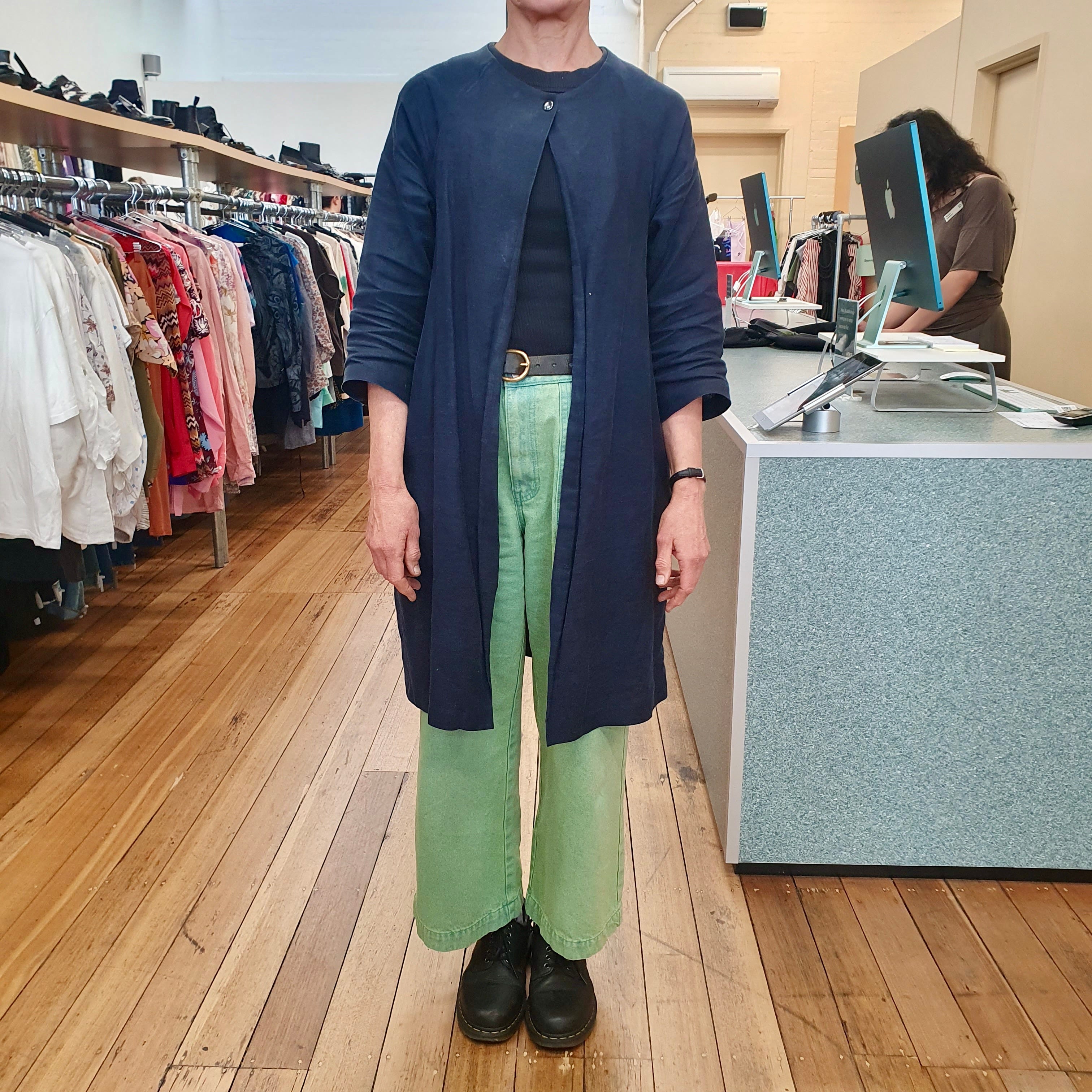
This year, as a late Christmas present to myself, during the sales, I bought a pair of green jeans that I’m wearing now. I don’t know what Freya would say about this purchase, as our friendship became awkward after James (who adored her sunny energy) left for Europe. What I do know is that I seem to have taken a roundabout path to accepting that I feel most myself when I wear clothes that don’t announce themselves, that don’t wear me and that I can do anything in across the day, without the hassle of changing them. Form and function matter to me, just as much. I care about how my clothes look, but I also care about what I can do, and be, when I’m wearing them.
I still like that checked dress, which I recently sold after wearing it out just the once. Which means that if I happen to see a woman wearing it in the street, I’ll silently salute her, feel a pang and go on my own way.
I really enjoyed this piece. I suspect it’s also a stage of life thing, I don’t have an ex husband but am confused about my clothing. Things I used to love no longer feel like me but I’m not sure what does feel like me.
I loved that Kowtow print too, but knew it was too loud for me, and it would wear me, not me wear it. Really enjoyed your relatable musings!