
sharp knives

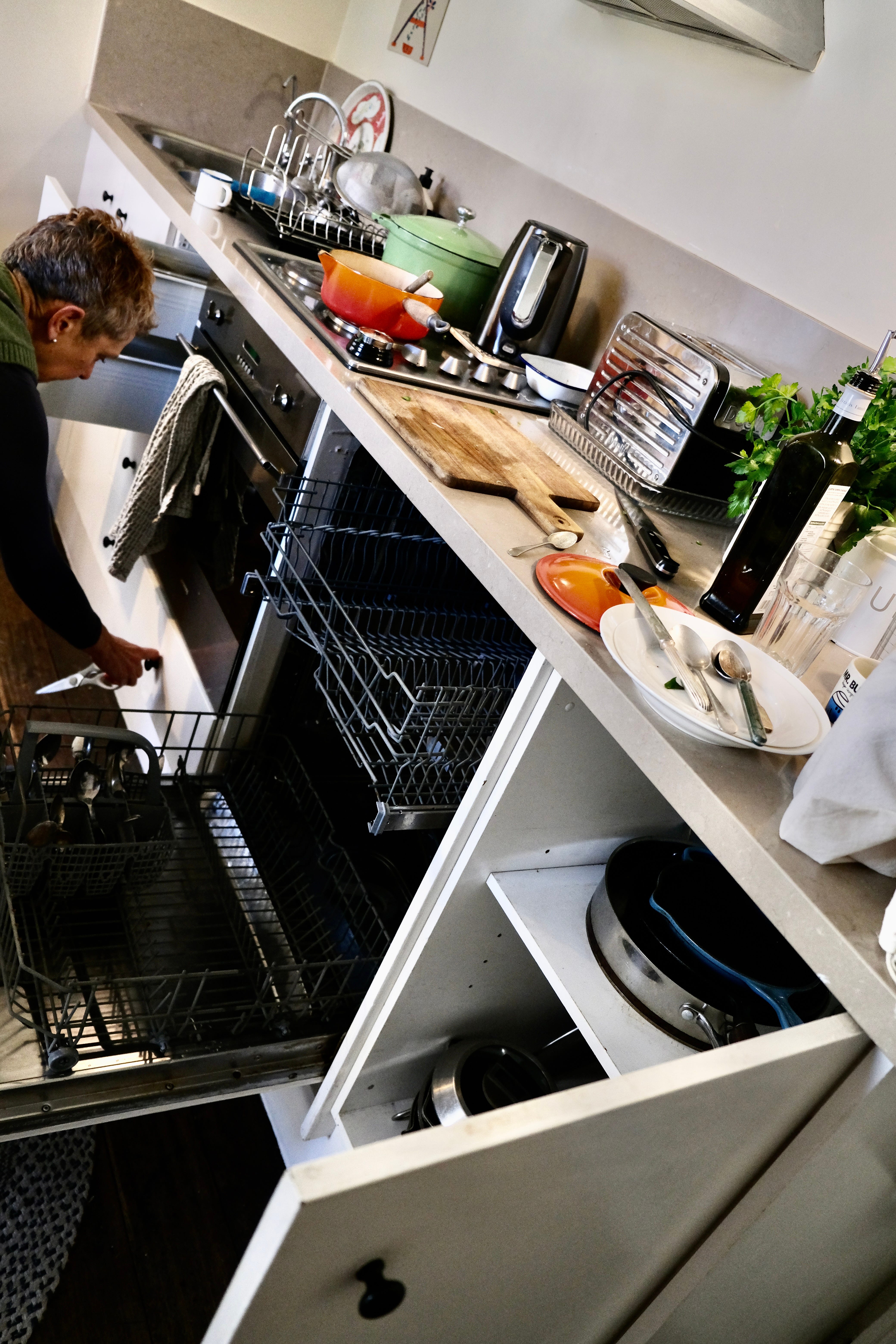
‘It’s in the kitchen that we cut through things, and to things, that have nothing to do with the kitchen. That is why it’s important.’
Nigella Lawson, On Eating
Recently, a passing comment from my daughter made me fume and squirm.
‘I bet’, she said, ‘you’ll enjoy cooking more now that your knives are sharp’.
As usual, she was right. It was astonishing what a difference newly-sharpened knives made on my experience of cooking, how pleasurable it felt to cut an onion, or kiwi fruit, with a gleamingly sharp stainless-steel knife. The kitchen knife slid through my morning grapefruit, turning it into perfect squares, while the black-handled carving knife glided through otherwise impenetrable pumpkin.
Over the years, I’ve asked scores of people how they feel about the time they spend in the kitchen. Their first response, unsurprisingly, was generally positive. It was only when I asked a follow-up question that a mixed picture came through. One woman told me that her favourite thing, at home, was to wander out into the garden and to pick a few herbs around which to base a meal. However, when I probed, she admitted that what she hated most, in the kitchen, was coming home late ‘and having to chuck a family meal on the table in under half an hour’. Her first answer was thoughtful, painted in pastel shades in dappled light, while her second answer was red and hot from the heart.
So why did I smart when my daughter told me that I might enjoy cooking more now that my knives were sharp? I think what got me most, was the idea that now that my play things were sharp, I might enjoy cooking more than I did before. But it wasn’t just this. It was also her use of the pronoun ‘your’. How come, I thought, the knives in the drawer of the kitchen, in which she ate most of her meals, were my knives and not our knives? Again, it wasn’t just this. I felt needled by her suggestion that I’d enjoy cooking more today, than I had yesterday, because from her considerable experience of watching me cook from the other side of the table, she didn’t think liked cooking very much. And lastly, I was riled by her comment’s confirmation that I was captain of the ship, that I was the boss who decided which ingredients to blunt my knives on, apart, that is, from rare occasions when the stars aligned and she herself cooked.
It is my unspoken policy, whenever I’m in the kitchen with my kids, not to say exactly what is running through my mind. I do this out of respect for the weird but true fact that, for as long as we’re in the kitchen together (and nowadays it’s only when we’re in the kitchen together), I’m still the boss. At delicate interpersonal moments, I don’t cut my kids down with my sharp tongue. What would the point of that be, especially if they took this as a sign for them to break ranks and follow suit?
The unspoken contract, which has perhaps always been the case between generations, is that my kids and I are allowed to tease each other but we aren’t allowed to humiliate each other. This can be a fine line to hold. Like every mother I know, I want my kids to feel they belong in the kitchen, that they feel held and respected there (whether or not they still feel it’s their kitchen). Especially now that they’re no longer kids and work hard to hold their own in the world. Not least, I’m aware of my tenuous position as a mother, of my need to be liked by my kids and, ultimately, for them not to withhold their love from me.
This is something of what has me slicing onions and carrots late afternoon, in the hope of a pleasant dinner that night (especially those days when I teach late and need something to look forward to when I arrive home hungry). And yet, of course, now my kids are grown up, they won’t be around to cook for much longer (my current rule of thumb is that my son only appears after the pot has been scraped clean). My days of an endless parade of family dinners, streaming into the sunset, are over, a thought which often crosses my mind as I dream up something, anything, for tonight’s dinner.
One of the most helpful and beautiful things that someone said to me, during my 60 conversations about the home, which inspires me in the kitchen, was this: ‘Anyone can burn the onions and turn cooking into a chore’, Tom said. ‘The real art is to focus on the next meal, and make that the best it can be. Not,’ he added, ‘the best ever, just bloody good’.
Recently, as I listened to Elizabeth Gilbert read her memoir, All the Way to the River (and believe me, it’s a very long way), my mind alighted on an acronym that she used for the word pause: Perhaps Another Unexpected Solution Exists. I loved this phrase the moment I heard it, and have used it often since. I use it to switch off my conscious, bossy and judgy brain in order to listen out for my quieter, softer responses that hover in the background.
When I pause, I stop smarting at my daughter’s comment about sharp kitchen knives. Equally, I stop wondering what on earth to cook for tonight’s dinner, and fretting about what I might dream up for tomorrow’s yoga class. I just pause and wait for the moment to pass.
By slipping into neutral, bypassing mild panic and instant judgment, I can trust that, as long as I hold my ego and superego in check, something will come up, as in reality it always does. When I refrain from reacting and wait for real life to step in and work things out in its own good time, I spare myself from spooling back and ruminating over how the heck my life has come to be as it is. I get a moment’s holiday, a breather from being me. I don’t have to fix or do anything, which always feels like gold.
When I don’t take the bait, and instead pause, I can see that it’s not my job to reverse the entire emotional history of my domestic life. I don’t have to unravel the tight interpersonal knitting that, over many years, made me into the boss in the kitchen, and that sometimes makes my competence in it feel like a burden. I can just get out my newly-sharpened knives, make this evening’s dinner the best it can be, and leave it at that. Nor, for that matter, am I compelled to look ahead with wonder and fear at what it might be like when it’s just me to cook for, night after night. Apart, that is, for one yellow Labrador who seems destined to pad under the kitchen bench, willing morsels of cheese and grated carrot to drop from the sky for evermore.
Then it came to me, the thing that had been bothering me all along, pierced by my daughter’s chance comment. I found my answer towards the end of a fluorescent-green covered paperback by Philippa Perry, The Book you Want Everyone You Love to Read. I was reading it before bed last night, mainly out of compunction, feeling duty bound not to waste an impulse buy. Dropped into a chapter on maturity, she writes: ‘Our strength is not in our resilience, it is in recognising and owning our vulnerability’ (p153). The phrase was delivered as a fact, the product of decades of working as a psychotherapist and as an agony aunt for The Observer. Sitting up in bed, I smiled and thought how incredibly British a thing that was to say, and that I couldn’t imagine an Australian or American writer saying the same, save perhaps Brene Brown.
Even as I read this sentence, and then again to check I read it right, I felt lighter. Just as I’d secretly hoped, Perry was suggesting staying open to what was to come is more important than defending myself from slings and arrows, whether from one of my kids or anyone else. It’s not that I don’t have to care what others think of me (knowing full well that mostly they’re not). It’s that when I can move on past a slight, or misunderstanding, and choose not to dwell there to prove myself right, I move to new ground. Not to higher ground, or even better ground, but new ground.
My job, and perhaps that of all of us, is to stay open to life, to not close down in an effort try and fix what has gone before. It’s to keep on showing up and being vulnerable, and to resist the urge to pull on armour. It’s to remain connected at the level of longing, of what might be, and what yet could happen, and to leave off the argy-bargy of ‘I’m right and therefore you must be wrong’. I’m not saying that this is the answer to everything, but it does seem to help in the kitchen, where the knives are sharpest.
I used to like cooking and regarded it as a creative outlet. Family life put paid to that and I've had to re invent the whole experience for myself. I've found both gardening and sewing and shopping (I used to love shopping) suffered the same fate. In time, my resistance to these things faded away and I was able to see them as neutral activities again - even dare I say personal expression; not burdens I was expected to take up or risk ostracism. Ready meals, instant and meagre gardening, buying clothes as if they were teabags, Red Dwarf replaced attempts to read Proust...iron on rufflette tape and two lines of knitting...discontinued ..
Having successfully ditched all responsibility to inspire my children I found a curious desire on their part to fill the vacuum (not the actual vacuum - but still)...my husband also took over the cooking it must be said, although not to my original standards..
25 years later I find my desire to create things is back - it's still quite tortuous disentangling it from family care but it's back - and I suppose I had to learn the hard way that as the children grow up, my being queen of their house was only a temporary role.
Yet you will always be queen of YOUR OWN house.